Tampilkan postingan dengan label driver. Tampilkan semua postingan

Sailing Alone Around The World

Selasa, 29 Maret 2016

0 komentar
No, not me! Definitely not on the bucket list! We are content to have sailed between Eastport, Maine and Grenada, West Indies -- only about 6,000 miles, round trip, less than a fourth of the distance of the equator and one must also put in a lot of northing and southing to circumnavigate. Europe still glimmers in my mind but is improbable. There are many ports in the areas we have sailed that we have not entered.  And the "alone" part has no appeal to me either. I believe that I could handle the boat but Im far too social an animal. Without Ilene it would be no fun. And in certain longitudes one encounters pirates. No thanks.

No, the sailor in question is Captain Joshua Slocum.  A New England Yankee retired merchant sea captain:  both square riggers and steamships. Slocum set off for his 38 month adventure when he was in his fifties during 1895-98. His was the first such long cruise for pleasure.

I read his account, a classic, at the suggestion of my friend Jim. It is quite interesting and well written with footnotes explaining some of his few archaic sailing terms and references to the personalities and current events of the day (meeting Stanley of Stanley and Livingston in South Africa; avoiding mines when entering Newport RI during the Spanish American War). He also included 65 illustrations (no photos) among the books 265 pages. These include his boats sail plan, lines, and other views and views of some of the more exciting incidents. His writing is better than mine but shares a common characteristic: an unemotional recounting of the facts which speak for themselves; he does not need to characterize them. He was opposed to witchcraft and I believe organized religion, and liberal in his political outlook except as to race and colonialism, in which he was of his times. He includes in the narrative as to each stop along the way, his dates of arrival and departure; from this someone could calculate the number of stops and the percentage of sailing days as compared to lay days, as I do in this blog at the end of each of ILENEs long cruises.

"Spray" his wooden gaff rigged sloop (reconfigured as a yawl half way round), was only 37 feet long on deck, compared to ILENEs 42 feet (but with a long bowsprit and aft extension for the sheet of the jigger, Spray was quite a bit longer than ILENEs 45 feet overall). She was 14 feet wide compared to ILENEs 12, with less draft, concrete ballast instead of lead and double the weight. And he had rebuilt her himself using hand tools on the hulk of an old fishing boat. And Spray had no engine or fuel tanks, no refrigeration, no GPS, no EPIRB, no chart plotter and no radio -- he was rather alone out there, taking pleasure in frequently referring to himself as "the crew of the Spray."

My interest in this book was enhanced when I toured a modern-day, fiberglass, larger-scaled replica of Spray at the dock of Marina Cay in Tortola in November of 2010, before Ilene and the kitties joined me there for our trip down to Grenada. The replica had modern amenities and was home to a family with several small children.

Slocum was a self educated man about writing as well as about the sea. I could not help but compare his chapters to posts of this blog. Of course my own adventures and accomplishments pale by comparison to his, qualitatively as well as quantitatively, but both of us are sailors who write. Generally, when I read, I find the stories interesting substantially to the extent that I can identify with and compare myself to the characters. There are a lot of things in this book to which I could identify.  He wrote comparing himself to the early explorers, who did not have accurate clocks or charts and found himself wanting; and I am not a fraction of the sailor he was.

Yet there are many episodes that resonated for me. He wrote that following a big storm he took out his palm and sewed a new sail to replace the torn one, calling it "serviceable if not beautiful". I recalled my adventure aboard On Eagles Wings this past winter during which I used such a palm to repair a sail.

He was given a set of books by the widow of Robert Louis Stevenson during a visit to her island in the South Pacific off South America. This put me in mind of the generosity to me of Eve, the widow of Selwyn, a great sailor of our club and a great mentor to me.

Nearing home Slocum encountered the USS Oregon, which I learned about in the Oregon History Museum. She signaled "CBT" -- i.e., "Are there any men of war about?", referring to Spanish warships, to which Slocum flew the negative flag.

An interesting unresolved question that this book raised involves usage. When I hail another ship, my usage, which I believe is the common one today, is "Ahoy [name of vessel]". The "Ahoy" serves to capture the attention of the listener to listen for the name of his or her boat. Slocum, if he greeted us would reverse this: "ILENE Ahoy!" There is a lot of "ahoying" in the book and it struck me as wrong each time. I wonder when and why the custom changed.

He described an incident in which he mistook the light of a lighthouse flashing on wave crests as a reef, way to close, and the scare it gave him, This reminded me a moment of horror of my own off the Maine coast one dark and stormy night in 1992 -- the moon peaked out from behind the clouds, low, near the water and I thought it was a strong light on a large ship crossing our bow.

Slocums description of the joy of a landfall at the end of a long voyage will resonate with every cruiser and his description of ports in my home waters --from New York to Maine -- were very rewarding.

He did not keep cats like ILENE and humorously described a short passage with a goat which had been given to him as a gift. He used rope instead of chain to tie the goat to the mast and after eating through the rope the goat ate Slocums hat and his chart of the Caribbean

He had a few groundings and was hit by another boat while at anchor; all things that have happened to me and are going to happen to you if you are out there enough.

He tried to tow a much larger boat that had grounded but the captain refused his offer and the ship was later lost. On my first boat, "Just Cause;" I went out from the safety of Three Mile Harbor (the back door of Easthampton, Long Island) to tow in a much larger sailboat, and during another Club cruise was the beneficiary of a tow from a power boat when both my engine and the wind failed (Thanks again, Stu).

News of Slocums voyage had spread and he was greeted as a celebrity in most ports, large and small, and fees were waived while he was feted by the local dignitaries. This has not been my experience.

He also traded in merchandise that he picked up along the way in Port A for sale in Port B; you couldnt take the merchantman out of him. And later in the voyage he was given the use of lecture halls to earn money by telling his sea stories.

The most exciting portion of the trip was his circumnavigation of the western half of Tierra del Fuego, which lies between the Strait of Magellan and Cape Horn. This was also where he encountered natives who were pirates. He had not intended to circumnavigate these islands, but upon exiting the Strait into the Pacific,   he was hit by a storm that simply blew him back south and east of the Horn. The book contains several charts of his path, and a separate one for the tip of South America where all of this action occurred.

Having transited a good part of the Pacific from an island 340 miles west of Chile in 43 days, he passed just south of the Marquesas without stopping there and continued for another 29 days nonstop to Samoa -- 72 days at sea. He read a lot underway and reported on what he read.

He also had many pertinent observations on the winds tides, currents mileage made good, sun sites, and such matters as crossing the Equator and crossing his own track.

One amazing feature of his boat and his own skills was that he could trim his sails so well that he could lash his wheel in place and let the boat steer itself for days at a time. Only once, in a storm, did he tend the wheel by hand for 30 hours. Many people doubted the veracity of this self steering assertion and he repeats it several times with an illustration of how he lashed the wheel but with the caveat that he could not vouch that boats with large overhangs, fore and aft, could perform this way.

This will be the last nautical book review in this blog -- for 2014. I plan to help a friend bring his boat from Essex CT to Annapolis at mid month.
Read More..

HYC Cruise Day 6 July 30 Lay Day in Block Island

Kamis, 24 Maret 2016

0 komentar
Blasts crew rented a car to tour the Island, by day, dined at the National on a gift certificate and reported that it was excellent.

True North remained aboard during the day to make sure their anchor was holding in the big winds and came in for dinner at The Oar. 

Everyone from Ohana and ILENE (except Ilene) rented bikes from Aldos at the Boat Basin for the big loop of the southern half of the island. First major stop was at the beach at the foot of Mohegan Bluffs. 

There the younger generation went for a swim while Bennett and Roger took a long walk west along the beach. I dont think I have ever been there at low tide before. It reveals where one can swim without fear of being crushed against submerged rocks by the breakers. Then a brief stop at the lighthouse for liquid refreshments as defense against dehydration. There we learned of the imminent plan to build a "U" shaped cup of windmill generators around the southern end of the island a mile or two off shore. We had lunch at Finns, where Bennett satisfied his craving for whole fried clams and Roger ordered this new (for me) treat too. Then marketing at the very pricey local market before returning the bikes -- 1.5 hours late for a half day (4 hour) rental but they did not charge us the extra ten bucks -- and we dinked back, except for Rolo and Chris, who went to the beach and returned by launch later

Dinner on ILENE for eight: from Ohana, ILENE and Shanghai. A weird assortment of foods that somehow came together magically.  A rain shower required us to migrate from the cockpit to the cabin. CJ enthralled us with stories from his interesting life. We eight were from China, the U.S., Guatemala and Denmark, and included speakers of about ten different languages.  Most of our dinner table pics are after the meal; eating seems to always take precedence over photography until plates are empty.
Rolo, Christian, Laura and Bennett

Jenny, CJ, Lene and Roger
Shanghais dink motor failed on the way over so they came in tow. And I towed them back. Maybe we can create one fully operative dink between Shanghais inflatable and Ohanas outboard. But, in fact, it appears that all of the places both boats intend to visit on their ways back -- yes we are at our furthest point away from City Island -- have either docks or launch service. The other alternatives are the blissful solitude of staying aboard a well provisioned boat or getting a lift from strangers.

Stay tuned.
Read More..

Optimist Building in Virginia Beach

Rabu, 23 Maret 2016

0 komentar
Al from Virginia Beach writes in and shares pictures of his project boat...

NOTE: ALS UPDATES CAN BE FOUND AT THE TOP UNDER PAGE TITLED "Virginia Beach Optimist Project"

Im building the boat for 3 and soon to be 4 grandkids. I sail and my 2 sons sail, so getting the little ones into it makes sense. The oldest is 8 but lives about 300 miles away, so when next summer comes and we get to our lake house hopefully the craft will be ready to use.

Im using West System to coat and put this together but am not glassing the boat - extra weight that I dont want or need. My boat is Maranti plywood, 12mm for the transom etc and 6mm for bottom and sides. Ill make my own foils from 12mm also.  For the "solid" wood I have found some very nice and cheap spruce. I plan to use some mahogany for the rub rails - I have some nice pieces. Almost at the point of fastening things together since today I got the chine bent and straightened - that was fun and am glad I had as many clamps as I have, but one never has enough clamps!

Steps:

I fished a piece of spruce out of my pond and tried again with bending a chine.  I figure that 24 hrs underwater with all the enzymes and slop in my lily pond should make it pretty bendable.

I clamped the stern and mid ship positions and placed the above type clamps to make it parallel.  Then I gently bent the end of the chine toward the forward bulkhead and did two things. First I used a long clamp around the chine and the nearer stringer. Then I hung my tool bag with saws, drills and assorted heavy items on the end of the chine. I never changed the weight but I applied the straightening clamps and gradually tightened the long clamp.


The whole process took no more than 45 minutes and I never heard a creak from the wood.  When the chine was finally in position I removed the long clamp and tool bag and attached the chine to the forward bulkhead with a clamp. Not a screw in it yet. I will let it dry for a few days before removing clamps and attaching with screws. Then Ill see how the skin fits.


Read More..

Directors Cut CRAB Delivery Skipper Freedom 21

Selasa, 22 Maret 2016

0 komentar

Click here for information about CRAB (Chesapeake Region Accessible Boating).

It somewhat pains me to admit this, but Ive done more keelboat sailing over this past summer than dinghy sailing. Ive been volunteering at CRAB (Chesapeake Regional Accessible Boating - my long time sailing friend, Dick White, is sailing director there) and Ive been kicking around the Bay with various groups in CRABs keelboats, the Freedom 21s, which were designed specifically for handicap sailing.

The blogmeister had to make a singlehanded delivery of a Freedom 21 from the home-port of Sandy Point State Park down to Annapolis (the Freedom 21s were sailing in Boatyard Bar and Grill fundraising regatta off Annapolis that Saturday). I took my trusty pocket waterproof camera and shot a very short video of the 6-7 mile jaunt (including selfie).


I was delivering the Freedom 21 down to Annapolis for the annual Boatyard Bar and Grill fundraising regatta, where, as it turns out, US Sailing had decided to feature this years regatta, and CRAB, in this well done video.


The local Chesapeake Bay sailing rag, Spinsheet Magazine, captured the elusive blogmeister crewing at a previous Wounded Warriors Regatta.


Photo courtesy of Spinsheet Magazine


Read More..

Happy New Year!

Senin, 21 Maret 2016

0 komentar
Happy New Year Fellow Boaters!

Some of us have put our boats away for winter while some in the south and in the islands enjoy boating year around. Whether you are using your boat or have winterized it, it is a good time to come up with a to do list for your boat for the upcoming season. Some examples of things to add to your list:
  • Is your safety gear up to date and does it meet federal and your state requirements? Here is a link for the USCG requirements: http://www.uscgboating.org/assets/1/workflow_staging/Publications/420.PDF
  • All boats with living space should have smoke alarms and carbon monoxide alarms, do you? If so, then this is a good time to change batteries if you have not done so.
  • Do you have an EPIRB? If so is the registration and battery in date?
  • Remove your hand held fire extinguishers and turn upside down and hit the bottom with your hand, can you hear the dry powder settle? If not your fire extinguisher might be compacted and need replacement. If any doubts you can have inspected professionally. When was the last time the fire extinguisher in the engine room last inspected?
  • Check you thru-hull vales, are the handles easy to turn, how do they look, corrosion, when was the last time they were serviced? 
  • Check all of the hoses and hose clamps, replace if needed.
  • Inspect your fuel lines and condition of your fuel system. Does your fuel system meet USCG requirements?
  • If you have lead acid batteries, check the electrolyte, are you batteries secure? Are the wire terminals tight?
  • If you have an inboard engine, how is the condition of your stuffing box, cutlass bearing? Is your engine aligned properly.
  • How is the condition of your lifelines? I often find lifelines that need replacement because of corrosion and cracks in the swage fittings.
  • If you own a sailboat, when was the last time the rigging inspected? 
  • On sailboats chain plates are often neglected. Inspect for water intrusion, pitting and cracks. I have found Thermal Imaging to be useful in finding signs of trapped moisture in chain plates embedded in fiberglass.
  • If laying your sailboat up for the season, this is a good time to remove your sails and have them inspected at a sail loft. Also it is a good time to order a new sail, some lofts offer discounts over the winter.
  • Make a list of improvements you want for your boat and get estimates and see if any yards are offering discounts for work completed over the winter.
  • For us with metal boats this is a good time to inspect our bilges, sail lockers, lazarettes, and engine rooms for corrosion. Insure these areas are clean. 
I am sure I could keep going, but you get the idea. I am wishing everyone a safe and enjoyable 2014!
Happy Boating!
Read More..

If It Is Monday This Must Be Helsinki

0 komentar
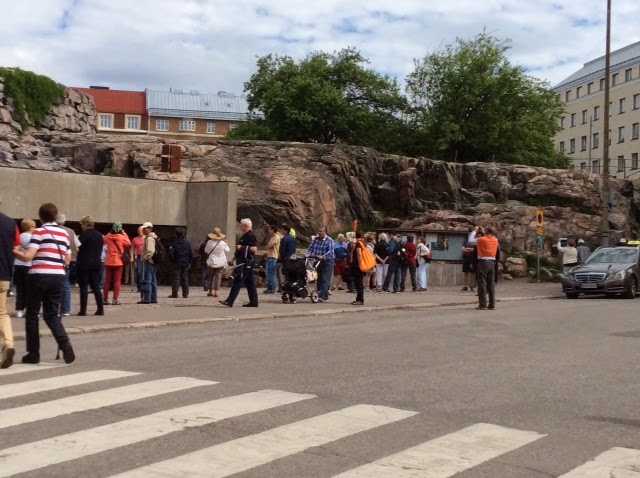
We took the shuttle bus in to town and explored with the map as our guide. A large modern Lutheran Church was built into a hole excavated from an outcropping of rock atop a hill.


A beautiful piano sonata was being performed; too bad not the organ. Oops, no cameras; I didnt see the sign.
The grand esplanade, one end of which abuts the market at the head of the inner harbor.


 There we saw this beautiful schooner with an old fashioned anchor on each bow, each weighing almost 900 pounds.


Shopping became the rage with Lene scoring a fur hat, suitable for Nanook of the North; except we will be south next winter so the chinchilla pelts will have to wait. We also got a bar of Salmiakki, a local delicacy: think chocolate covered licorice. The sweetness of the milk chocolate mixes with the salty/sourness of the liquid center. Dont laugh. Salted caramel is a big hit now so maybe the Finns really have something here. My personal taste test result: Meh.

Three other behemoth cruisers were in port today.


We were docked next to a boat storage yard with several boats not launched yet for this season. Hmmm, like at the Harlem YC. You can see  two large marinas behind seawalls across the way
.We could have seen more of Helsinki in our five hours here if we had taken a tour.
Read More..

Virginia Beach Project Update

0 komentar
After letting the last coat of epoxy on the hull dry for several days I did minimal touch up sanding of high spots. As I look back I should have done a lot more from an appearance standpoint but it certainly has a passable appearance. I again wiped the hull down well after having vacuumed the garage so that I was in as dust free as possible. I then used masking tape around the gunwale line feeling that the glue would probably adhere better to the epoxy directly than to a coat of paint. I used Rustoleum Marine primer, one coat applying it with a foam roller. It was difficult paint to stir and get well mixed but it went on very well and the roller gave it a good smooth even appearance. I again let it dry well for a couple of days and then used Rusteolem Marine Topsides paint for a finish coat. It too was rolled on and was easy to use. It will take a second coat to achieve a really nice look. It should be noted that this is Topsides paint not designed as “bottom” paint so if you plan on leaving a boat in the water for any long periods of time this is not the paint to use.


One final comment on the paint. Compared to the usual marine paints Rustoleum is much cheaper but also offers a more limited choice of colors and it would appear that it is not designed to be used as a mixing base to make your own color.


I let her get good and dry and then flipped her over onto a nice soft cloth pad to protect the paint. The frames were still attached and were the way I supported the boat while painting. Now for the first time I got a good look at the inside of the boat. WOW! I had a lot of finishing to do. This included filling screw holes but mainly if was filling in and making filets were the chines, keelson etc. did not seal as tightly as I would have liked. From a functional standpoint the boat was sealed. From and esthetic one I had a lot of work ahead of me. Since the epoxy is pricey I mixed up just enough so I knew that there would be no waste. This was your peanut butter consistency and applied with a tongue depressor went on easily and gave a nice effect. I would give a piece of advice when doing this. Wipe off the excess with a vinegar soaked cloth as soon as you are finished with an area. It is a heck of a lot easier than sanding this rock hard stuff once it dries. 


I still had the frame “legs” uncut. The center ones in particular were a real nuisance to work around so I cut them off almost to where they will be finally but since I still have work to do on the sheer as far as trimming off the plywood I left a few inches that will come off later. Now I at least wasn’t catching myself on this stick that was serving no purpose. The bow and stern legs weren’t nearly the problem and I still haven’t touched them. I went off the CABBS plans for the mast step and thwart. I saw in someone’s plans that they had enclosed this part and made a buoyancy box out of it. I used ¼” maranti for the top which I fitted up tight to the underside of the inwales. Put a few cleats along the sides and fore piece to hold it tight. I then scribed a pattern on cheap plywood for the vertical piece. For this I used ½” maranti figuring that this would be extra cross bracing since I am using ½” plywood instead of the ¾” per plans. I will cut a 2 3/8” hole at the point 11” back from the bow and into this will go a piece of 2” PVC. When finished it will be sealed with epoxy.

What I haven’t got straight (so to speak) yet is the rake of the mast and exactly how the step will be angled. The mast will be reinforced 1 ½” PVC. From what I can tell, and Kyle Leonard has said, the mast should be perpendicular to the sheer line That is what I finally did. I took a piece of 1x4 sprude, used a 2 3/8’ hole saw an cut completely though it and attached it to the keelson in just the right position so that the 2” pPVC would be perpendicular to the sheer line. Not as difficult as it may sound. Used epoxy to fasten it. I put in a 4” water tight inspection port in the vertical piece a little off center so that the area may be used to store a towel etc. I will have pictures of all this. The port cover is frm West Marine and cost less than $10. Really happy with it. As looked at the inside of the bow transom it just looked unfinished so I took a piece of 1x4 spruce, as clear as I could find, and scribed a piece to fit on the inside of the bow on top of the mast thwart. I think it looks pretty good. I am doing the same on the stern with the exception that there will be a perpendicular piece running down to the keelson. Since the gugeons will attach here the added strength makes sense. BUT all this trim work adds weight to the boat so for those wanting the lightest craft possible all this is not for you.
Read More..

October 6 Oriental to Morehead City 19 5 Nautical Miles

Sabtu, 19 Maret 2016

0 komentar
We had to get our sea legs back. But while it was calm in Whittaker Creek, it was blowing hard, though probably not as hard as our new wind measuring instrument shows -- calibration needed -- once we left its shelter.  We could have beat the first five miles crossing the Neuse River, but after that is was mostly canal-like waterways with the wind strong in our faces from the southwest and we motored all the way and did not set a sail.  Approaching Morehead City/Beaufort a pod of perhaps 20 dolphins passed us, going upstream, in groups of two or three at a time, their black fins, and later their backs revealing them. Sorry I could not catch a picture; I was at the helm. This military assault landing vessel was going out Beaufort Inlet to the sea while we were approaching it from the north.
Our first stop was a fuel dock, which was tricky getting into, and back off from with all that wind, but we took on 45.8 gallons, our first refueling since Annapolis. I figure that since Yorktown, we have been burning .66 gallons per hour.
We had several choice anchorages picked out but with all this wind we took a spot on the dock of Sanitary Fish Market and Restaurant for $25 if you eat here.
We were joined for dinner there by Deb and Terry of "Island Time," a 42 foot Brewer cutter-rigged cruiser, the boat that is tied up behind us and enjoyed good conversation but sadly, very mediocre food.
They are from Midland Michigan and plan a five winter campaign to cover the Caribbean, all the way to Panama and the Central American coastal nations, leaving the boat for the summers. He was an engineer for a chemical company and she retired as a professor of biology.
           For tomorrow I planned two options. The first is to go out of Beaufort Inlet and back in at the Masonboro inlet near Wrightsville Beach. This is about 75 miles, but 69 of them a straight shot in the ocean, where we can go straight and fast. They predict 20 to 25 miles of wind from the NW, so it would be a speedy beam reach and close to shore so that the big seas will not have had a chance to build up and winds diminishing by five knots in the afternoon.  The alternative is a two day passage to Wrightsville Beach via the Intercoastal. The problem with this second alternative is the midpoint anchorage -- Mile Hammock Bay located in Camp Lejeune. Specifically, the Coast Guard is advising that the ICW will be closed tomorrow for military exercises involving firing live ammunition in the direction of Mile Hammock Bay. So the inside route may require us to spend another day here. A variation on plan B, mentioned by our new friends during dinner, would be to anchor at Swansboro, about ten miles short of Camp Lejeune with a rather longish run in the ICW the next day.  After dinner, while we walked four blocks to the postoffice and back Lene prevailed upon me to forego plan A for fear that even if we left at first light, we would have only 11.5 hours before it got dark, meaning that we would have to make 6.5 knots to get there before dark. Plan for the worst is her mantra. And Lene did not relish rising before daybreak and a rough passage and I like a happy crew. Lets check the weather again in the morning.
Read More..

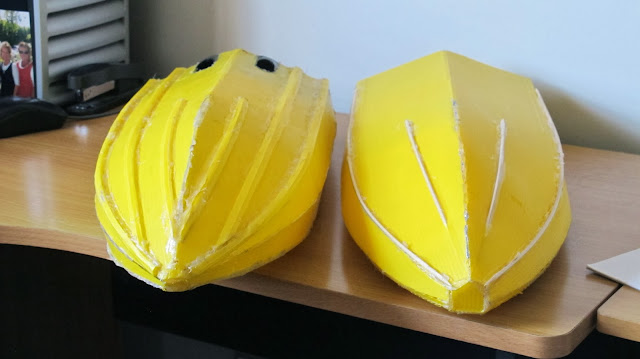
Someone else building a Yellow boat in Blue Coroplast

0 komentar
Someone else  building a Yellow boat in Blue Coroplast

Blue Boat 1 a single piece of Coroflute


Yellow boat 1 and 2

Yellow Boat 3 

Yellow Boat 4 Balsa ply Epoxy Fiberglass tape


Read More..

Header Photo Monotype du Bassin dArcachon

0 komentar


The Bursledon Blogger got this right. The previous header photo was of a beach gathering of the traditional lug-rigged dinghies from Frances Arcachon Bay. You can read more about the traditional sailboats of the Arcachon Bay over here.

Read More..

505 Dinghy and Annapolis 2017

0 komentar
I wandered over to my old sailing club, Severn Sailing Association, on Sunday and ran into Ali Meller, just in from Laser frostbiting. Ali is a long time 505 racer and I was interested in finding out how preparations are going for Annapolis to host the 505 Worlds in September, 2017. The 505 fleet at SSA is relatively small, ten boats or so, and to take on such a high-profile regatta as the 505 Worlds must be a daunting task for such a small group. To pull this one off, the 505 fleet has gone out to the Annapolis sailing community. Two yacht clubs are sharing the responsibility in running the event, SSA and Eastport Yacht Club and the RC is being recruited from the best of Annapolis. Given the strength of the dollar Ali expects the Worlds fleet to be around one-hundred, which, for North America, is huge numbers for a two man high performance dinghy.

Below is a great 505 promotional video shot by Chris Love, who does all of the Intercollegiate sailing reporting in the U.S. Although the 505 aficionados interviewed in this video downplay the intensity of the class, make no mistake; to race at the top level in the 505 is just below the commitment of an Olympic campaign. A true fanatics performance class.


International 505 Promotional Video from Chris Love on Vimeo.

Two photos of the 505 from the Earwigoagin archives; these taken at a SSAs Tuesday night series a couple of years ago.

Photo John Zseleczky

Photo John Zseleczky

For those who have dug back in Earwigoagin, you may have come across the fact that the blogmeister raced Internatonal 14s back in the 1970s and early 1980s. The International 14 of those years was very similar to the 505, single trapeze, big symmetrical kite. The modern International 14 has developed into a skiff but I occasionally wonder what the International 14 would look like today if it stuck with the rig of the 1980s - probably very similar to the current 505. A photo of the Canadian Harvey brothers ripping it, I think in 1980 (just had to sneak this in).

Photo Ellie Martin

Read More..

Spira International 27 Foot Boat Plans Build Costs

0 komentar
This will be my first keel up boat build.Well,unless you count the single person knock together boats I have built.I have rebuilt and restored a number of boats by myself and with friends.I even held a job doing interiors and upholstery in boats.

The one main factor is the cost of building the hull and cabin.I will layout the cost to build the 27 foot trailerable Spira International boats.I am using the bill of materials(BOM) off of the study plans that are available on the Spira International website.Its good to be able to get an idea of what costs are involved before building.Most other designers require you to purchase a study plan to get an idea of whats involved to build their design.You may still be required to buy the full plan set to get the BOM.This is a bad business practice in my mind.With the BOMs in hand,I started getting the numbers together and adding up cost.I will layout the cost break down and then give some ideas on how to cut some costs.I will start laying out things and end with the boat I have chosen as the design I plan to build.

The Elements of Boat Strength

Suppliers for pricing are as follow.
Lowes Wood supplies.
Home Depot Wood supplies.
Raka Epoxy and fiberglass.
Fastenal Screws and bolts.
McMaster Carr Screws and bolts.
DuckworksBBS Duckworks carries some of the odd size screws called for in the plans.

Avoid treated woods as much as possible.Treated wood usually contains traces of copper which corrodes fasteners and any other metals that come in contact with it.Even painted it can still leech copper.Also,copper is bad for the marine environment and is illegal to use in bottom coatings in some areas.

I prefer A/B fir plywood but will accept A/C fir,if its good quality.Avoid plywood with voids and footballs if possible.

I only use stainless steel fasteners for the extra corrosion resistance.Most of them will be sealed in with epoxy.I only use Raka epoxy kits with non blush hardener.

50 inch width is considered standard width for fiberglass boat cloth.Try to purchase all of your fiberglass cloth at one time.It saves a lot of money.

Bahaman Hull only No BOM for cabin.
$105=240 ft. 2x4
$40= 38 ft. 2x8
$60=2x stock for transom splash well
$78=180 ft. 1x4
$75=170 ft 1x4 decking-You can use decking or epoxy coated and painted 1x4 choice is yours.
$50=1x stock for rail cap-A good hardwood works well but is costs more.
$297=9 sheets 1/2 in. plywood
$195=5 sheets 3/4 in. plywood
$219=500 #10x3 in. screws
$196=2000 #8x2 in. screws
$338=5 gallons epoxy
$259=50 yards 6oz fiberglass cloth
_________________________
$1912=total

You can look at the cost of other models to gain and idea of the cost to build a cabin.I estimate between $300 and $500 depending on length of the cabin.

Chubasco
Hull Only
$264=8 sheets 1/2 in. plywood
$142=10 sheets 3/8 in. plywood
$103=240 ft. 1x4
$79=180 ft. 2x4
$341=1000 #10x2 1/2 in. screws
$30=250 #8x2 in. screws
$76=5/16x4 in. machine screws
$26=5/16 in. nuts
$9=5/16 in. washers
$60=12 ft. 5/16 in. threaded rod-washers and nuts included above price
$5=four 1/4 in.x 4 in. lag screws
$338=5 gallon epoxy
$25=3 in. glass tape 50 yards
$311=60 yards 6oz fiberglass cloth
_____________________________
$1809=total

Decking
$36=80 ft. 1x4
$99 =3 sheets 1/2 plywood
$25=250 #8x1 1/2 in. screws
$30=deck finish
_____________________________
$190=total

Cabin
$29=62 ft. 1x4
$58=2 sheets 5/8 in. plywood
$165=5 sheets 1/2 in. plywood
$25=250 #8x1 1/2 in. screws
$55=2 quarts epoxy
$46=8 yards 6oz fiberglass cloth
____________________________
$378 total

$2377 total hull,deck,and cabin

Cane River
Hull only-The cost for Chubascos cabin would be close.
$284=20 sheets 3/8 in. plywood
$462=14 sheets 1/2 in. plywood
$131=300 ft. 2x4
$47=240 ft. 1x3
$50=55 ft. 2x8
$341=1000 #10x2 1/2 in. screws
$188=100 5/16x4 in. screws
$26=100 5/16 in. nuts
$9=100 5/16 in. washers
$245=2500 #8x2 in. screws
$608=10 gallon epoxy
$622=120 yards 6oz fiberglass cloth
_______________________________
$3013 total

San Miguel
Hull only-The cost for Chubascos cabin would be close.
$142=10 sheets 3/8 in. plywood
$330=10 sheets 1/2 in. plywood
$172=6 sheets 5/8 in. plywood
$105=240 ft. 2x4
$55=280 ft. 1x3
$16=32 ft. 1x4
$171=500 #10x2 1/2 in. screws
$196=2000 #8x2 in. screws
$798=15 gallons epoxy
$518=100 yards 6oz fiberglass cloth
________________________________
$2503 total

Sitka
This is the boat I am planning to build.I will stretch it to 30 feet and build the V entry bow per the plans.
This total will be to build Sitka at 27 feet.Add approximately $200 to $300 to build to 30 feet with the V bow.
Hull Only
$105=240 ft. 2x4
$85=125 ft. 2x6
$30=32 ft. 2x8
$50=100 ft. 1x4
$199=14 sheets 3/8 in. plywood
$396=12 sheets 1/2 in. plwood
$113=6 sheets 5/8 in. plywood
$451=60 yards 6oz fiberglass cloth
$498=8 gallons epoxy
$97=300 #10x3 in. screws
$98=1200 #8x1 1/2 in. screws
$176=60 ft. 1x8
_______________________________
$2298 total

Cabin
$31=64 ft. 1x4
$141=48 ft. 1x8
$462=14 sheets 1/2 in. plywood
$XXX=12 yards 6oz fiberglass cloth-price included in bulk order above
$182=2 gallon epoxy
$25=200 #8x1 1/4 in. screws
______________________________
$841

$3139 total for hull and cabin

Newfie.Some may notice that I didnt include Newfie.I really like that boat, but it has a very small interior and there was no BOM on the study plans.

Boat Building Manual

There are some ways to cutting material costs.I added a few above.

Lumber.Find a local saw mill and have the lumber cut to full boat length.You could also use trees from your property.Make a deal to get your lumber ordered filled and let the mill have the rest to sell as payment.This can be tricky as some saw mills are mobile while others require you to haul your wood to the mill.This option takes longer and requires a place to store the wood while it finishes drying out.The best option for most people will be finding a local builders supply.They get huge loads of lumber with a volume discount.If you buy enough,they sometimes will negotiate for  lower price.Also,there wood tends to be better quality than most places like Lowes and Home Depot.

Fasteners.I recommend finding a local supplier and purchasing everything at once plus 10% to build the hull and/or cabin.Later when you need fasteners and hardware to finish out the boat,you can possibly negotiate for a slight discount on pricing.Hey,every little bit helps.

Epoxy.Some epoxy manufactures set a shelf life for their products some do not.I have had epoxy either, go bad, or it was a bad batch.Which,I am not sure.Epoxy is heavy and can get expensive.Try to buy in bulk to save on cost and shipping.Its best if you can find a dealer or supplier.Be careful tho.Their mark up may be a lot higher than ordering a kit.Shop around.I like Raka because they have an easy mixing system.

PL glues.I have had bad experiences with these, so I stay away from them.My main gripe is the ability for PL and epoxy to stick together.I built a knock together plywood boat and when I sheathed it in fiberglass and epoxy,the area around the PL let go.I wont knock PL glues, but theyre not for me when boat building.


My next installment will include more ways to cut cost during fit out and finishing.


Practical Encyclopedia of Boating


Read More..

The Archipelago Rally Uncovers another Gem The International 12

Kamis, 17 Maret 2016

0 komentar
Last years Archipelago Rally uncovered a historical gem with the entry of Yarrow Thornes Crosby Skimmer Moth. This year, another historical rarity made an appearance at the Archipelago Rally; Woody Underwoods International 12. (this is the American International 12, not to be confused with the lapstrake, George Cockshott 12 Dinghy, which is also sometime referred to as the International 12 and popular in Europe.) The International 12 was the first sailing dinghy to be built using hot molded veneers held under pressure in an autoclave, a building method that allowed mass production of a very strong, lightweight monocoque wood hull. It was a very revolutionary technology but also a temporary technology as fiberglass construction of boats came to the fore in the late 1950s, early 1960s. Thousands of wood boats were built post WWII using hot molded, autoclave construction. Most were small outboard runabouts but some are the familiar sailboats of today including the Fairey Marine and USOD International 14s, Thistles, Luder 16s, Fireflys, Jet 14s, and Jollyboat.

Woody Underwoods International 12 appears to be one of the first in the production run. Woody comments:
"My father bought this boat (# 31) in 1940, and it could be the first boat I ever sailed in. He was away in the service after that, and the boat was washed off its float in Padanaram in Hurricane Carol, ending up in the bushes 2 miles away. About 1960, we put in an Interclub mast, and I have sailed the boat on and off since then. Condition is good, albeit dried out.

Woody and Josie Whoolam sailing in the 2015 Archipelago Rally. Woody has retained the natural mahogany veneer look on the outside of the hull.

Photo from Rufus Van Gruissen

The International 12 was designed by International 14 designer, Harry Hall, who lived in New Rochelle, New York.

Photo from Woody Underwood

The first hot molded boats had very little internal structure - a feature designed to show off the strength of the new construction. The lack of ribs and stringers was a source of amazement to most.

Photo from Woody Underwood
The wood International 12 was also used by the U.S. Coast Guard Academy for their sail training and dinghy racing program.

Photo from Woody Underwood

Ernest Ratsey sailing the International 12 prototype in the summer of 1940.

The Rudder, October 1940


On a slightly different topic but still about the 2015 Archipelago Rally:

One cannot wrap up the 2015 Archipelago Rally without featuring the latest video report from the Tuthill Sisters. Last year, in the 2014 Rally, the younger sister had to become a human sidestay when the mast on their dinghy started falling over. This year the duo rolled out a Sailfish for the race, a choice that looked like a safe bet compared to their previous rickety dinghy and the slow - slow Snark, but the Sailfish has no cockpit and, sometime during the race the older sister ended up in the drink (she kept filming though).


Read More..

April 12 14 Fernandina to Jekyll Islands Harbor Marina 23 9 Miles

0 komentar
Amazing! This is the 365th post to this blog since it began in October, 2010.

We were underway from 8:15 to 2:30.  We went very slowly up the west side and north side of Cumberland Island, across St. Andrews Sound and up Jekyll Creek, on the west side of Jekyll Island. A new stretch of the ICW for us. We went slow because we wanted to arrive when the tide was an hour before high. We passed the huge Kings Bay submarine base, but without sighting any of those killing machines. We passed Cumberland Landing,
on the north side of that island, where the packet boat used to land. We also passed the abandoned lighthouse and saw a buoy that has apparently detached from its mooring and washed ashore. The NY Times had a nice article about the men and women of the Coast Guard vessel that services the buoys in the NY area. In the ICW most "aids to navigation" are not buoys, but numbered red triangular and green square signs posted on pilings -- cheaper to maintain.
But this passage, with a few quite shallow patches, was deep water, 40 to 50 feet, deep enough for nuclear subs, so buoys are necessary.
This Marina is a well loved one, essentially a long dock along the east side of the creek to which all the transient boats are tied, this from its free postcard.

Here is ILENE under the live oak tree from the shower house, laundry and restaurant. Her mast, with its distinctive double forestay is in the center.
My first chore was to change ILENEs engine oil and filter. The marina takes waste oil for $2 per gallon, and I paid $2.50. We have a good pump that sucks waste oil out of the engine through the dip stick hole. You have to run the engine to get the oil hot before sucking it out but this was not a problem in that we had been running since early in the morning. But I realized that when you think you have gotten all the old oil out you have to wait to let more of it drip down to the bottom so you can suck out more of it. This time I pumped one pump to many and some oil gushed out from the bottom of the canister onto the cardboard box that I had set under it to catch spills. Im hoping I did not ruin this tool and will be able to fix it. I was also able to twist off the old oil filter without dropping it and spilling its dirty contents under the engine. Patience, and resting and drying hands just before it came off was the key. Lene helped out at the stage when you pour the dirty oil from the canister of the pump into the recently emptied oil cans for disposal. She steadied the receptacle and the funnel while I poured. No mess! Then, using a tiny bit of laundry detergent and a stiff brush, I got rid of 99% of the remaining one percent of the pelican poop from the blue canvas.
 The Marina is extremely friendly and provides good, movie watching quality, wifi; Lene has watched a lot of TV shows. They also have bicycles and a golf cart, which we used for the limit of 90 minutes per usage, for shopping at the IGA.
It is a very small store with limited selection and high prices on the east (Atlantic) side of the island, which is being developed with homes and hotels. The one drawback is insects, which bite, especially Lene. Rain has been predicted for the last week, including very high probability several of the days, but it did not come. During this passage the grey lowering skies suggested rain but it did not come until about an hour after our arrival, and lasted for about eight hours.
Because we were spending three nights and two days here, I asked the marina staff for the names of people who wash bottoms, change oil of outboards and align propeller shafts. Leo Ross, 912-266-1323, looked at the alignment, first. "Well", he said, "with the problem being intermittent and only at certain speeds, it might not be an alignment problem at all. Lets take a look."  I had cleared out the aft compartment so everything was ready for him. "Whats this? A motor mount bolt!" he quickly noted, picking it up from the bilge. It seems that the engine was held on its shock absorbing mounts by only three of the four bolts and those three were loose too. And the flange at the forward end of the propeller shaft, which is held in place on the propeller by two set screws, was also loose! After everything was nice and tight, I ran the engine at pretty high speeds in forward and reverse while tied to the dock and so far it looks good, very good indeed. But the acid test will be trying this while underway.
As to the outboard, it needed both its engine oil, which I had, and its lube oil, which I did not have, to be replaced after its 20 hour break in period. And the latter requires a special tool to force the new oil in from the bottom hole until it flows out of the top hole. I will get that tool for next time. Leo went to Westmarine on his break and bought the lube oil. He let me help him and taught me how to do this, including whacking the screwdriver with a hammer to shake lose the tight seal.
Leo looks like a refugee from that Dynasty Duck program but he is a set man, a good teacher, knowledgeable and charges a very fair amount A diver came and scrubbed the bottom and reported that my zincs have 75 to 80 percent left but that the wheel that, when not clogged by seaweed tells us how fast the boat is moving through the water (as compared to over the ground), is broken.
With all of the repair activities we did get time to use the pool and hot club, or do the sightseeing I would have liked. They have a free museum which also offers a $16 guided tour train ride through the historic old town district on the islands western side, which the Macys and Goodyears and other people of wealth set up in the 1890s. A reason to come back! Our last evening we did have a pretty good meal at the annex of the historic dowager but quite busy Jekyll Island Club Hotel, where the rich hob nobbed -- and still do. The Club sent over a van to pick us up and bring us back to the Marina.
Read More..

Bennetts Beneteau

Selasa, 15 Maret 2016

0 komentar
I had the pleasure of sailing with Bennett, Ed and Ian on Bennetts new Beneteau, 37 feet long built in 2011 and quite beautiful and fast.
Ed and I left our cars at the Harlem and got into the rented car at 7:30 A.M on May 30 for the ride up to North Wickford,  RI.  The boat was almost ready to go. But I noticed that one section of the stainless steel tubing that holds up the bimini had come loose from the socket which holds it in place and was dangling, though fortunately the two allen head set screws which clamp it into the socket were not missing. So during Bennetts drive to drop off the car, he picked up a tool kit and the broker went and got his allen wrenches and this was fixed. This repair was at the bottom of the diagonal from the upper right down to the left, to the built in starboard davit.
We also got a bottle of Spray Nine cleaner and took up a lot of the pollen that coated the boat -- another disadvantage of being on the land.
I was all in favor of not dropping below five knots to make sure that I got home reasonably early so as to not miss the flight that Lene and I are taking to Amsterdam today, the day after our arrival. But it was tough at first using the motor only. Somehow we seemed to have good tide at first and good wind later, after we got south of  Point Judith and headed west to home. 
We departed at 1:20 pm and arrived at City Island at 10:20 am the next day, May 31 -- 21 hours for the 130 nautical mile passage, almost six knots. Two rainstorms before dinner, the first light and the second heavy, showed that the new boat is toasty dry inside. I am calling her "the new boat" because her current name is "Ohana" (I wonder what that was all about) and Bennett has not yet selected her new name.
Dinner was fine despite confusion as to provisioning. We had trouble finding the switch that controls the solenoid that lets propane flow from its tank to the burner. We also found that the yard had not done a good job of flushing all of the propelene glycol (pink antifreeze) from the fresh water tanks. The water had a funky taste and smell, so we used bottled water to boil the pasta. And we had only one pot so after draining the pasta (no strainer or pot holders so I used the lid to keep the pasta in and clothing to hold the pot) I poured the jar of vodka sauce (which had been placed in the refrigerator) into the pot and with low heat and stirring it all got warm. The only utensil was a spatula but with it and fork we got the pasta onto plates.  No salt, pepper or grated cheese but it was warm and filled our bellies. We also had confusion about the accompanying salad. We had four prepared packaged bowls of Ceasar salad that I had not known about. And redundantly, we had lettuce, tomato and cucumber, but no dressing for the salad I had planned to make. So I added some of those fresh vegetables to the prepared salad, used its dressing and again, the crew was happy.
 Ian and I were off duty from eight pm until one am. So we missed the passage through The Race, which I was told was made at 7.5 knots speed over ground, near the slack. 
We have tentatively decided that the boat does not have a speedo to measure speed through the water, and no instrument to display such, or at least we have not founds such yet. The relevant speed, except for racers, is SOG, with water speed useful only to know how much positive or negative effect the current is causing. SOG and depth ( and we do not yet know whether depth is calibrated as actual number of feet of water, like on ILENE, or number of feet below the keel, which some prefer) are shown in data boxes on the Raymarine radar/chartplotter display. It is a larger and newer model than ILENEs. 
Bennett has to learn how to use this tool better, which will come with reading the manual and playing with it. We were shown a control for changing the brightness, which must be turned way down at night, but we forgot how to do it and could not figure out how to do it once it got light in the morning whereupon we could not see the screen. But we also had two Ipads with iNavX, so our position, course to waypoint and speed were always known. Our use of the Raymarine unit as a chart plotter had to end earlier when we ran off of the edge of the chart. The prior owner had the electronic chip containing the charts for New England. This extended only to the waters of extreme eastern Long Island Sound and we sailed off the edge it its "known world".
We had experimented with the sails, including the in-mast roller-furled main, with vertical battens, but the wind was either too light and or too much in front of us from the west to be used consistently and so we had motored the whole way until about 3 am when the wind came up on our starboard side in the teens, and we sailed home on a beamy close reach and made up to seven knots.  The boat is beamy and carries her beam well aft making her stiff (stable against excessive heeling) and roomy. Both sails are drawing well but both could use an inch or two of luff tension next light wind day. Their halyards can both be led aft to the cockpit.
She has an interesting and clever hatch board. It has a built in lock at the bottom, is hinged at the top from which it lifts up and aft and then slides in horizontally, forward, under the coach roof. So there is no need to find places to stow the hatch boards and lock. Her built in cockpit table has wide side extensions and a socket in which to plug a detachable electric lamp for evening enjoyment on the mooring.
The propane tank is rather smaller but there is room in the locker for a second one. The locker is a rather flimsy thing with a strap to hold down its lid, located on the deck in the port aft quarter. (To reach it, you lift up the helmspersons seat to starboard and then the port quarter of the cockpit bench tilts lifts up and outboard to port revealing a space for a life raft and the propane locker.) The less rugged construction of the propane locker is not unsafe because in the unlikely event that propane leaks, it will leak out into the cockpit sole and thence flow out over the stern, which is quite open save for two lifelines, and not up across the raised threshold at the companionway into the cabin. There is very little backrest for persons seated on the sides at the aft end of the cockpit and at the helmspersons seat. So at least one of those blue folding seats with back rests will make for more comfortable seating. She has many fewer lines than On Eagles Wings, but most of them are not whipped, so there is still something I can do to be useful during future sails.
Bennett, Ed and Ian on the Harlem launch
All told it was a very easy and pleasant passage and upon returning to the Harlem I drove Bennett and Ian to Bennetts home in NJ. 

Read More..

Copyright © 2014-2022 Sailboat Plans | Powered By Blogger